THE
BASIC OR ‘FREE’ DEVELOPMENT PROGRAM
by Dr. Lawrence Wilson
© October 2024, LD Wilson Consultants, Inc.
All information in this article is for educational purposes only. It is not for the diagnosis, treatment, prescription or cure of any disease or health condition.
Contents
History
Questions and Answers
1) The Alkaline Reserve or Development Diet
2) A Healthy Lifestyle
3) Nutritional Supplements
4) The Detoxification Procedures
IV. THE FREE PROGRAM FOR CHILDREN
V. THE FREE PROGRAM FOR PREGNANCY AND LACTATION
________________________________
This article describes an introductory development program that you do yourself at home. To learn about the effects of the program, read the Testimonials Page.
This article only presents the program. The reasons for the recommendations are found in the reference articles. This article presents a program for adults, and modifications for children, and pregnant and lactating women.
We also offer a more powerful, supervised healing program that is described later in this article.
HISTORY
The development program began about 50 years ago. It combines many recent findings from nutrition and other healing sciences.
Dr. Larry Wilson has a medical degree and 44 years of experience with the development program. More than 50,000 people have done the program with excellent results. Click here to read about Dr. Wilson.
QUESTIONS AND ANSWERS
1. Why is it called the development program? Because the program causes a deep type of healing that is called development. For details, read Introduction To Development.
2. What does the program involve? The program has four parts:
a) A specific diet. Do not combine it with other diets.
b) A healthful lifestyle, with lots of rest.
c) Seven nutritional supplements – and not other vitamins, minerals, or herbs. You can remain on prescribed medication, if needed.
d) Several powerful detoxification procedures.
Of these, the diet is the place to begin. It is an alkaline, gluten-free, omnivorous diet. Begin with the diet. If you skip the diet, the program will not work.
3. Does everyone feel better? No, but many people benefit from the starter program.
The complete or full program is more powerful because it is individualized and supervised, but many people like getting started on their own, so we offer this program, as well.
4. How much does it cost? Not much – perhaps $150.00 US dollars per month. The cost is for the correct food, the nutritional supplements and the cost of coffee for enemas, at least one reddish heat lamp, and a socket for it. Spring water is helpful, as well.
The free program saves $150-250.00 USD when starting out. However, it is not necessarily less costly than the supervised program. The reason is that the Helpers who supervise the full program often give a discount on the nutritional supplements. Over a period of six months or so, the savings pays for the consultation and testing fees.
NOTE: Modifications for children, mothers-to-be, and when breast feeding are described at the end of this section.
THE ALKALINE RESERVE OR DEVELOPMENT DIET
Basics of the diet:
1. Begin each meal with a small portion (4-5 ounces or 110-140 grams) of one or perhaps two protein foods. Recommended proteins are sardines, chicken, turkey, lamb, and a little natural or organic beef, almond butter, sesame tahini, goat cheese or goat yogurt. Do not overcook meats. Read Cooking for details.
Also, women may have up to 6 eggs per week and men may have up to 8 eggs per week. Only cook eggs by soft boiling for 3 minutes or poaching or light frying. The yolks should be runny.
In addition, have 2 tablespoons daily of roasted almond butter and 2 tablespoons daily of roasted sesame tahini. Also, have one teaspoon daily of nutritional yeast. You can sprinkle it on vegetables or other foods.
AVOID all pig products, all shellfish, all fish except sardines, most processed meats such as salami, bologna, and hot dogs. Also avoid vegetarian diets, protein bars, protein powders and smoothies.
2. Next have 1-3 cups of cooked, not raw vegetables. The best vegetables are all onions, shallots, leaks, green onions or scallions, carrots, green beans, daikon radish, red cabbage, brocollini, and a small amount of celery, garlic, ginger, and horse radish.
The best way to eat vegetables is to eat a mixture or medley of 10 or more types of vegetables at each meal.
Cook with water, either pressure-cooking for about 2 minutes or steaming. Other methods are not as good. Vegetables should be cooked until soft. Ideally, they will retain their color.
AVOID green drinks and vegetable juices except for 10-12 ounces of carrot juice daily, if you wish. Fresh vegetables are best. Canned vegetables are okay if you cannot get fresh ones. Do not eat frozen vegetables.
3. Next have about 8 to 10 blue corn tortilla chips. Currently, our favorite brands are Garden Of Eatin No Added Salt and Late July Blue Corn Dippers, (not the blue corn chips). Avoid other chips and have other grains sparingly. We do not recommend wheat or bread.
AVOID fruit, sugar, honey, maple syrup, agave nectar, coconut products such as coconut water, coconut cream or coconut milk, soda pop, fruit juices and most milk. Also, do not eat sweetened foods such as cookies, cakes, ice cream, pastries, all desserts, and many breads.
4. Use sea salt with all meals. An excellent brand is Hawaiian Alaea sea salt. Hain is not too bad. Use sea salt to taste, including on meats. It is an important product for development. Sea salt in moderation does not raise blood pressure or cause other problems.
AVOID standard table salt, which is a processed and toxic product. Also avoid salt substitutes such as potassium chloride.
5. Adults need to drink about 96 ounces of either spring water or carbon-only or sand-flltered tap water. Avoid other beverages. Do not drink with meals. Drink up to 10 minutes before a meal or an hour or more after meals.
For a more detailed explanation of the diet, go to:
1. Reduce stress wherever you can by living simply. Also, do your best to live and work in a safe location with clean air, peace and quiet. Try to do work that you enjoy, and do your best to surround yourself with people and things you enjoy.
2. More rest is critical for most people. Do your best to get 9-10 or more hours of sleep every night. Also, go to sleep early, between 8 and 9 PM. This will give you the most restful night’s sleep. Naps are also excellent. You may feel tired, at times, as healing occurs.
3. Gentle exercise only is best. Most people are tired and limiting exercise helps conserve most of your energy for healing. Good types of exercise are gentle walking, hiking, bicycling or perhaps swimming in lakes, oceans or rivers. AVOID swimming pools, due to toxic chemicals and infections.
Although some health authorities will disagree, it is not necessary to exercise vigorously. Even Kenneth Cooper, the founder of aerobics, discovered this after a number of people dropped dead of heart attacks during vigorous exercise routines.
4. Deep breathing. Do deep breathing every day for at least 15-30 minutes.
5. Minimize sexual fluid loss. This means to limit regular sex to no more than once a week, and less if you are tired or debilitated. However, Down Sex and Down Hugging are excellent and extremely healing.
6. Sunshine. Sun exposure for 10 to 20 minutes daily is very good. Do not remain in the sun for hours, because this is toxic, even if you wear sunscreen. Most suncreens are toxic, so please do not use them.
7. Reduce toxic exposures. Reduce all chemicals on your skin such as perfumes, nail polish, cologne, lotions, etc. Also beware of lawn chemicals, pesticides, solvents, paints, and other toxins. Use only natural products with as few chemicals in them as possible.
8. Root canal-filled teeth. Root canal-filled teeth almost always harbor serious infection, even if you cannot feel it. Most often, it is best to have the tooth removed. This can be extremely important in order to regain and maintain your health. It is essential if you have cancer.
9. Silver amalgam dental fillings. If you have silver amalgam dental fillings, begin now to have them replaced, preferably with composite resin fillings. The silver amalgams contain mercury that is extremely toxic.
AVOID fluoride treatments and do not get metal braces on your teeth. The metal usually contains nickel, a potent toxin.
10. Minimize electromagnetic pollution. If possible, use a wired land telephone, rather than a cell phone. If you must use a cell or portable phone, hold it away from your head or use a headset or speakerphone.
Turn off all electrical devices when you sleep, and keep them as far away as possible from you at all times.
11. Minimize and preferably avoid using medical drugs and most over-the-counter drugs. Most are toxic. If you need a prescription drug, continue it for now.
References: Healthy Lifestyles, Understanding Stress, Rest And Sleep, Exercise, Breathing, Sun Bathing, Mercury Toxicity, Electromagnetic Stress, Toxic Metals, Toxic Chemicals
1. TMG or trimethylglycine. This excellent supplement helps with toxic metal removal and much more. It is a methyl donor.
Dosage. Women can take 1000 mg daily. Men can take up to 3000 mg daily. Children over about age 6 can take a little. Children age 6 or younger do not usually need TMG.
Reference: TMG
2. Megapan or a similar multi-mineral/multi-vitamin product. Megapan is from Endomet Laboratories. If you are trying to match it, it has no copper and no iron in it. It also has about 10 mg of each of the B-complex, and a little selenium, zinc, and chromium. These are the main ingredients to match.
Dosage. The dosage is three tablets daily for adults, and fewer for children over the age of about 6. This product is not for children under age 6.
3. Kelp capsules. This is an excellent source of iodine and minerals. WARNING: Kelp causes a powerful healing reaction in a few people. Always begin with only half a capsule of kelp daily and work up slowly.
Dosage. Begin with half a 600 mg capsule daily and work up slowly.For adults: take up to 3600 mg of kelp daily, and less for children.
Children under the age of about 5 do not need any. Only use the following brands: Nature’s Way, Solaray, Endomet or the other brands mentioned in the article referenced below. You may also take about a tablespoon of kelp granules from Frontier Herbs or Monterrey Bay Herbs. Other brands may be toxic.
Reference: Kelp
4. Omega-3 fatty acids. This is an important anti-inflammatory supplement most everyone needs due to modern agricultural practices and modern diets.
An excellent source is fish oil. Cod liver oil and fermented butter oil do not work as well, in my experience. Krill oil is somewhat toxic and not recommended.
Dosage. Adults need about 1200 mg daily, and less for children. Children under age 5 do not need any.
Reference: Omega-3 Fatty Acids
5. Vitamin D3. This is another very important supplement.
Dosage. Adults should take 4000-5000 iu daily. Give less for children. Children under age 5 do not need a supplement.
Reference: Vitamin D
6. Calcium, magnesium, and zinc. Everyone needs a supplement of these three minerals.
Dosage. Most adults need about 750 mg of a quality calcium product, 450 mg of a quality magnesium product, and about 20-30 mg of a good zinc product. Chelated minerals are good. Very fancy is not needed.
The form of the minerals should be chelates, lactates, citrates or other high quality minerals. Some people need more than this. Even babies need a calcium and magnesium supplement, but not much zinc.
Reference: Calcium, Magnesium, Zinc
7. A powerful digestive aid. This should ideally contain ox bile and pancreatin and be a potent product.
Dosage. We suggest one from Endomet Labs called GB-3, at a dose of one to three tablets per meal. Children less than age 6 or so do not require a digestive aid.
NOTES:
1. The above are the ONLY supplements we suggest unless you decide to send in a hair sample to begin a complete development program.
2. NatureMade is a decent and very inexpensive brand of supplements sold online and in many supermarkets and drugstores. They usually work well.
3. Some supplement brands do not work well, no matter what they cost. We use Endomet brand of supplements from Phoenix, Arizona, USA. Do not use Carlson fish oil or Nordic Naturals fish oil. These don't seem to work as well.
These are very helpful and necessary for some health conditions. Always begin with the diet, not with the healing procedures. Add the healing procedures once you are on the diet.
1. The Pulling Down Procedure. This is a very simple, yet powerful mental exercise that is required for rapid development. It is calming, centering, grounding, and brings a healing energy into the body. Do it ideally for two hours each day. For details, read The Pulling Down Procedure.
2. The spinal twists, pops, pulls and kicks. These simple movements will help keep your spine loose and in alignment. They can work as well as some chiropractic or osteopathic care. Do them once or more daily. For details, read The Spinal Twists, Pops, Pulls And Kicks.
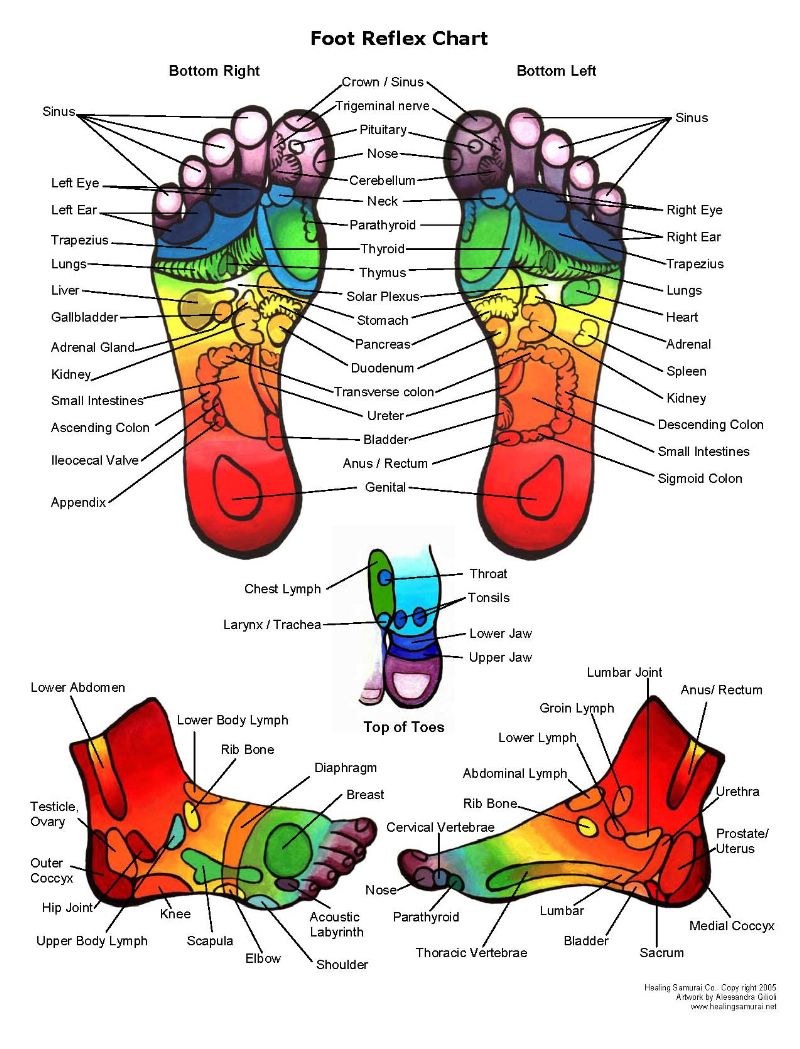
3. Foot and hand reflexology. Reflexology involves firmly pressing on reflex points on your feet and/or hands. Be sure to press on the bottoms of the feet, the tops of the feet and all around the toes and the ankle.
This simple, safe, and very powerful procedure balances the body, releases toxins, helps relax the body, and improves many symptoms.
We suggest doing it in the morning and before bed at night. Ten minutes for each foot is sufficient in most cases. For details, read Reflexology and look at The Foot Chart.
4. Daily shining a reddish heat lamp on the abdomen for one hour or daily use of a red heat lamp sauna for 20-30 minutes. This is a wonderful and safe healing and detoxification procedure. Regular use enables the body to eliminate hundreds of toxic chemicals and two dozen toxic metals in a few years that would otherwise take much longer.
The red light sauna or reddish heat lamp therapy also helps improve circulation, hydration and oxygenation of the body. Near infrared lamp saunas are dry, clean and use very little electricity. Free plans are on this website. For details, read Single Lamp Therapy and Sauna Therapy
5. 1 to 4 coffee enemas daily. Coffee enemas are remarkable in their ability to remove toxins from the liver and colon. Done properly, they are so safe and a powerful that we always recommend with a development program. While not mandatory, they greatly speed up healing and development. For details, read Coffee Enemas.
6. The Neck Pull. This is an excellent, simple healing procedure. It takes a little practice to learn it. For details, read The Neck Pull.
6. Others. The procedures above are the most basic ones. In addition, there are about 25 other healing procedures that are excellent in certain cases. For details, read The Accelerators.
1. For safety and for best results, follow instructions exactly. Do not add, omit or change anything! Do not follow the advice of some other health practitioner.
2. Do not combine this program with other nutrition programs. This almost always wrecks the development program.
3. Weaning off prescription medication. Don’t stop prescribed medication when beginning this program. Often, after a while you won’t need prescribed medication, but this can take a few months or longer.
4. Weaning off replacement hormones. The program will slowly rebuild your glands. This will usually make it possible to wean off replacement hormones unless the gland has been surgically removed or destroyed with radiation. This includes thyroid, adrenal and sex hormones.
Continuing to take replacement hormones of any kind will eventually impair the program. Blood tests may indicate that you must have the hormones, but we find that that the blood tests are not necessarily the only way to assess your glandular activity.
5. Healing or purification reactions may occur. These reactions are common on the development program and indicate deep healing. Old illnesses and traumas come up to be healed.
When these healing reactions occur, many people become frightened and quit the program, thinking they are becoming more ill. However, this is not true. You may read about this in the article entitled Purification Or Healing Reactions.
6. Development is not really a do-it-yourself program. We suggest contacting one of the Approved Helpers as soon as possible, so you will have supervision. This works much better than doing it all on your own.
Doing the program all by yourself usually does not work well because:
- Changing or ignoring even one aspect can ruin the program.
- Some people become frightened when they have a healing reaction, even though it is a welcome sign.
- Some people are talked out of the program by friends, relatives or doctors. Having a helper to consult can assist you to handle all these problems, and others that can arise.
- You cannot depend on your medical doctor, naturopath, family members or friends for support. They are simply not familiar with the development science principles and their application. Please read Why Development Is Not A Do-It-Yourself Program.
IV. THE ‘FREE’ PROGRAM FOR CHILDREN
Diet. The diet applies equally to children. However, children under about age 8 to 10 must usually have some fat or oil with each meal, along with their cooked vegetables. They also must usually have many fewer grains, cereals and other starches. This is because they are usually fast oxidizers. For details, read The Oxidation Types – Fast, Slow, Mixed and Four Lows.
Supplements. All supplement doses must be adjusted down for children based upon their weight. Also, do not give vitamin D, omega-3 fatty acids, kelp or TMG to children under age 5.
Procedures: We do not recommend the pulling down exercise for young children. However, babies and children benefit a lot from a single reddish heat lamp on their abdomen and/or back. The light must strike their skin.
Children less than about 5 years old can use a lamp for 5 to 10 minutes. Over age 5 or 6, increase the time with the lamp to 10-15 minutes. Over age 9 or 10, increase to 20-40 minutes.
Children can also benefit from coffee enemas, the spinal twists, pops, pulls and kicks and many other healing procedures. References: The Baby Manual, Children’s Health.
V. THE FREE PROGRAM FOR PREGNANCY AND LACTATION
In our experience, the development program is excellent to prepare for pregnancy and during pregnancy.
Program modifications for pregnancy:
1. Diet. No changes. If extra iron is needed, begin by eating a little more red meat and green vegetables.
2. Supplements. Be sure to take at least one Megapan tablet or equivalent during pregnancy to provide enough folic acid, calcium and other supplementary vitamins. This is usually much better than the pre-natal vitamin prescribed by most physicians.
3. Detoxification procedures. Limit sauna therapy during pregnancy to about 10 minutes on the abdomen and the rest on the back. Too much on the abdomen can upset the baby inside. The other procedures are safe and very good during pregnancy.
Program modifications for lactation:
No changes are needed while breastfeeding. Taking the supplements is very important for mother and baby.
Rarely, during lactation a baby will become colicky due to a supplement the mother is taking. One must experiment to figure out which supplement is causing problems. Sometimes changing the time one takes the supplement relative to feeding times will help the problem.
PROGRAM UPDATES
The articles referenced in this article are updated as we learn more. The most up-to-date information is found on the New Earth Newsletter.
THE COMPLETE DEVELOPMENT PROGRAM
After beginning this program, the next step, if you so choose, is to embark on a more precise and more personalized development program. The full program combines the above with more specific instructions.
In addition, an individualized program will include several more food supplements based on your hair analysis patterns, and more precise instructions on the use of the detoxification procedures. In addition, the hair mineral test may offer other clues and information that may help us design a more personalized program for you. For more on this topic, go to Find A Practitioner And Begin A Development Program.
Development is the activation of the full genetic potential of a human being. For details, read Introduction To Development.
Home | Hair Analysis | Saunas | Books | Articles | Detox Protocols
Courses | About Dr. Wilson | The Free Basic Program